Quick Answer:
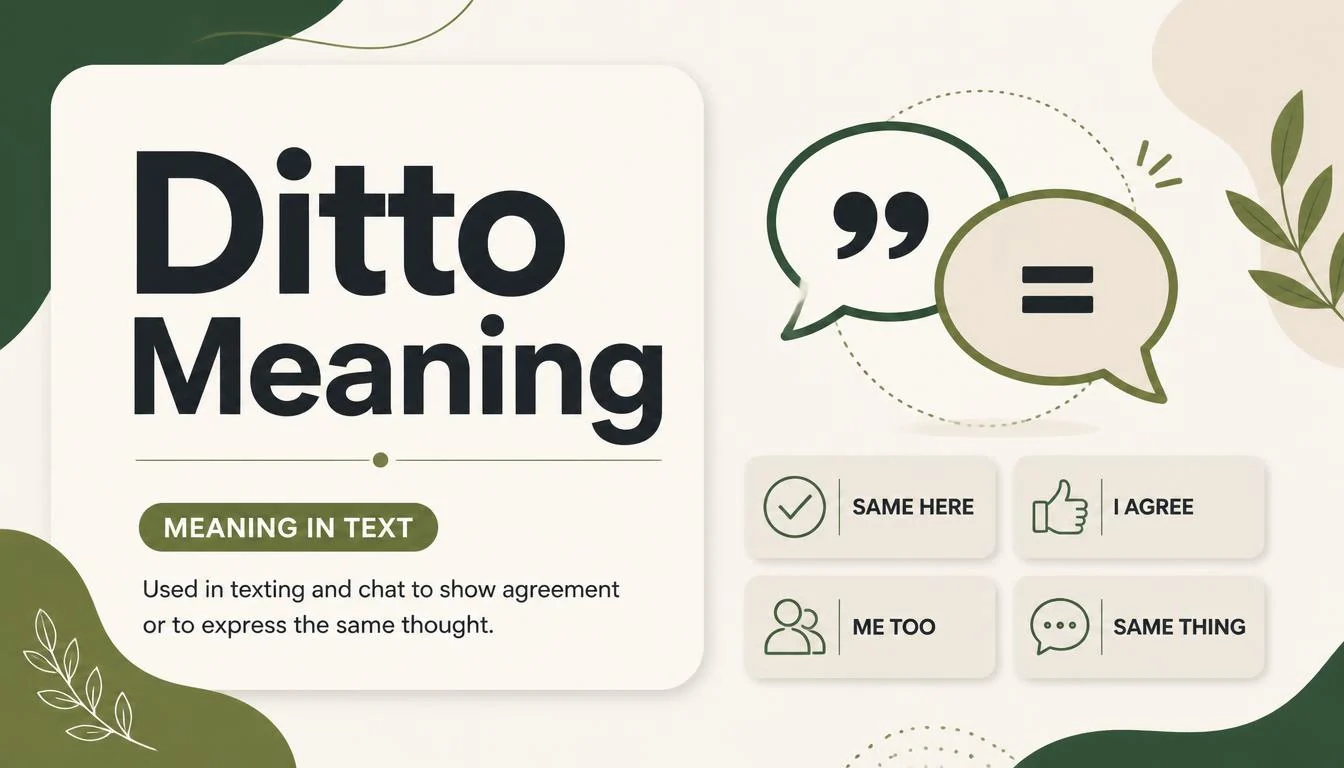
Ditto means “the same,” “me too,” or “I agree with what you just said.” People use it to show that they share someone’s opinion, feeling, or statement. For example, if someone says, “I love this song,” you can reply, “Ditto!” to mean you love it too.
The word ditto is a simple, casual way to say that you feel the same way as someone else. Instead of repeating a whole sentence, you can use this one word to express agreement or show that you have the same opinion.
You’ll often hear ditto in everyday conversations, text messages, and online chats. Whether someone says they’re excited about the weekend or agrees with your favorite movie choice, replying “ditto” is a quick and natural way to say, “Same here!”
What Does Ditto Mean?
The word ditto means the same as something already said or written. In everyday conversation, people often use it as a short response when they share another person’s opinion, feeling, or experience.
Imagine that your friend tells you, “I’m so ready for the weekend.” You feel exactly the same way. Instead of repeating the entire sentence, you can simply say, “Ditto!”
According to the Cambridge Dictionary, the word can express agreement with something just said or help avoid repeating information.
The word has two main uses:
- Expressing agreement: You share another person’s opinion, feeling, or experience.
- Avoiding repetition: You refer to information that someone has already mentioned.
Although these meanings are connected, they aren’t always interchangeable. In a text message, ditto usually communicates a shared feeling or opinion. In a list or document, it may indicate that the information above applies again.
What Does Ditto Mean in Texting and Chat?
In texting, ditto is a quick way to say “me too” or “same here.” It helps you respond naturally without typing a long explanation.
People commonly use it in messages between friends, family members, partners, and coworkers. The word can sound playful, warm, casual, or matter of fact depending on the situation.
For example:
- Friend A: “I’m craving pizza right now.”
- Friend B: “Ditto!”
- Friend B means that they want pizza too.
You might also see the word in online comments. If someone posts, “This is my favorite movie of all time,” another person might comment, “Ditto.” That short reply communicates agreement.
Ditto Meaning in a Text Message
A text message containing ditto usually refers to the statement immediately before it. The sender shares the same feeling or agrees with the point being discussed.
Consider this conversation:
Alex: “Today has been exhausting.”
Jordan: “Ditto. I need a long nap.”
Jordan feels tired too. The reply acknowledges Alex’s experience while keeping the conversation moving.
However, context matters. If someone says, “I hope you have a wonderful day,” replying “Ditto” means you wish them the same. It doesn’t mean that you’re agreeing with an opinion.
Ditto Meaning in Online Chat and Social Media
On social media, people often use ditto to show support or agreement with a post or comment.
For example:
Comment: “Everyone deserves a little kindness.”
Reply: “Ditto!”
The reply signals agreement with the message.
You can use the word in group chats, Instagram comments, online discussions, and other casual conversations. Its basic meaning stays the same across these platforms.
Is Ditto Slang or an Abbreviation?
Ditto is an established English word rather than a texting abbreviation. People often consider it informal because they use it frequently in casual conversations.
Unlike abbreviations such as LOL or BRB, the word doesn’t stand for a longer phrase. It already has its own meaning.
Although it isn’t limited to slang, its short and relaxed style makes it especially useful in texting. It can also appear in ordinary writing when the context calls for it.
What Does Ditto Mean in a Conversation?
In spoken English, ditto lets you express agreement without repeating another person’s complete statement. It can also show that you share a preference or experience.
Here are a few common situations.
Ditto as a Way to Agree
Suppose your coworker says, “That meeting could have been much shorter.”
You agree with the comment, so you respond, “Ditto.”
Your response means that you share the same opinion. It doesn’t require you to explain why you agree.
People also use the word when discussing movies, books, food, travel plans, or everyday frustrations.
Ditto to Express Shared Feelings
Imagine that your friend says, “I’m really excited about our vacation.”
You can reply, “Ditto!” to show that you feel the same excitement.
The word works with both positive and negative feelings. For example, if someone says, “I’m nervous about the interview,” your response can show that you feel nervous too.
Still, remember that ditto doesn’t explain the strength of your feelings. If the situation is serious or emotionally important, a fuller response may sound more caring.
Ditto to Avoid Repeating Information
The word also appears in sentences that describe similar situations.
For example:
“The first restaurant was crowded. Ditto the second.”
This means the second restaurant was crowded too.
Another example is, “The manager was rude and unhelpful. The assistant was ditto.” The second sentence sounds unnatural in modern English. A clearer version would be, “The manager was rude and unhelpful. The assistant was the same.”
A more natural construction is “The manager was rude and unhelpful. Ditto for the assistant.”
These examples show why context matters when interpreting the word.
What Does Ditto Mean in a Relationship?
In a relationship, ditto usually communicates shared feelings or affection. Its meaning depends on what the other person said and how you normally communicate with each other.
For example:
- Partner A: “I’m so happy we’re together.”
- Partner B: “Ditto ❤️”
- Partner B is saying that they feel the same happiness.
Between close friends, the word can also express shared excitement, frustration, or appreciation. It doesn’t automatically indicate romantic interest.
What Does Ditto Mean as a Reply to “I Love You”?
When someone says “I love you” and receives “Ditto” in response, the word usually means “I love you too.”
For example:
- Person A: “I love you so much.”
- Person B: “Ditto ❤️”
- Person B is likely returning the affection.
However, the response sounds more casual and less direct than saying “I love you too.”
Some people use ditto playfully because they enjoy short, familiar expressions. Others may prefer a more explicit reply. You shouldn’t judge someone’s feelings based on this word alone.
If you’re unsure what the person means, consider the wider conversation rather than reading too much into one short message.
How to Use Ditto in a Sentence
You can use ditto as a short reply or within a sentence. The best choice depends on whether you’re expressing agreement or referring to something already mentioned.
Here are some natural examples.
Ditto as a Short Reply
- “I could really use a vacation.” “Ditto.”
- “This coffee is amazing.” “Ditto!”
- “I’m excited about the concert.” “Ditto.”
- “I can’t wait for the weekend.” “Ditto!”
In each example, the second speaker shares the first person’s feeling or opinion.
Ditto in the Middle of a Sentence
The word can also refer to another person or situation that shares a previously mentioned quality.
Examples include:
- “The first team performed well. Ditto for the second.”
- “She disliked the new schedule. Ditto her coworkers.”
- “The restaurant was expensive. Ditto the hotel.”
These sentences communicate that the same statement applies to another person or situation.
Ditto in Written Lists
In written records, ditto can save space by referring to an entry above it.
For example:
| Item | Color |
|---|---|
| Shirt | Blue |
| Pants | Ditto |
| Jacket | Ditto |
Here, ditto means that the pants and jacket are blue too.
In modern documents, repeating the actual information may be clearer. This matters when people need to read a table quickly or interpret important details correctly.
Ditto Examples in Everyday English
The following examples show how the word works in different situations.
| Context | Example conversation | Meaning |
|---|---|---|
| Friendship | “I’m ready for the weekend.” “Ditto.” | I feel the same. |
| Food | “I love spicy noodles.” “Ditto!” | I love them too. |
| Work | “That meeting was unnecessary.” “Ditto.” | I agree. |
| Travel | “I’d love to visit Italy.” “Ditto.” | I want to visit Italy too. |
| Relationships | “I miss you.” “Ditto ❤️” | I miss you too. |
| Movies | “This is the best film I’ve seen all year.” “Ditto.” | I share that opinion. |
| Daily life | “I’m exhausted after work.” “Ditto.” | I’m exhausted too. |
| Written records | “Monday: 10 orders. Tuesday: ditto.” | Tuesday also had 10 orders. |
Notice how the meaning changes slightly with the situation. Sometimes ditto expresses agreement. In other cases, it confirms a shared experience or repeats information.
Ditto Synonyms and Alternative Expressions
Several English expressions have a meaning similar to ditto. However, the best alternative depends on the situation.
| Synonym | Meaning | Typical use |
|---|---|---|
| Me too | I share that feeling or experience | Casual conversations |
| Same here | I feel or experience the same thing | Texts and everyday speech |
| Likewise | The same applies to me or you | Polite conversations |
| Exactly | I strongly agree with a point | Opinions and discussions |
| Agreed | I support that opinion or decision | Meetings and discussions |
| Same | A short expression of similarity | Informal messages |
| As above | The same information applies as stated earlier | Documents and lists |
| Similarly | In a similar way | Explanations and formal writing |
These alternatives aren’t identical in every situation. For example, exactly emphasizes agreement with a statement, while me too usually expresses a shared feeling or experience.
Ditto vs. Me Too
Both expressions can communicate that you feel the same way as someone else.
For example:
Person A: “I love chocolate ice cream.”
Person B: “Me too!”
You could replace “Me too!” with “Ditto!” without changing the basic meaning.
However, me too often sounds more direct and personal. Ditto can feel playful or slightly more casual.
Ditto vs. Likewise
Likewise means “in the same way” or indicates that the same sentiment applies in return.
For example:
Person A: “It was nice meeting you.”
Person B: “Likewise.”
Here, the response means that Person B also enjoyed meeting Person A.
You could sometimes use ditto in a similar situation. However, likewise generally sounds more polished in polite introductions and professional conversations.
Ditto vs. Same Here
Same here usually means that you share another person’s feeling, opinion, or experience.
For example:
Person A: “I’m hungry.”
Person B: “Same here.”
Both same here and ditto work in this conversation. The difference is mainly tone and personal preference.
Ditto vs. Exactly
Exactly expresses strong agreement with a particular statement or point.
For example:
Person A: “We need better planning before starting this project.”
Person B: “Exactly.”
The second speaker agrees with the argument. By contrast, ditto can express agreement without emphasizing the accuracy of the original statement.
What Is the Opposite of Ditto?
The opposite of ditto depends on its meaning in a particular sentence. Since the word can express agreement or indicate repetition, it doesn’t have one universal antonym.
When ditto expresses agreement, possible opposites include:
- I disagree.
- Not me.
- I feel differently.
- I don’t think so.
When it refers to repeated information, words such as different, another, and unique may express the opposite idea.
For example:
Person A: “I prefer tea over coffee.”
Person B: “Not me. I prefer coffee.”
Here, the second speaker clearly expresses a different preference.
Ditto Pronunciation
The word ditto has two syllables. In American English, it is pronounced /ˈdɪt̬.oʊ/, with the stress on the first syllable.
You can listen to the pronunciation through the Cambridge Dictionary’s audio guide.
The word is short and easy to pronounce once you recognize its two syllables. You may hear slight differences between American and British English, especially in the final vowel sound.
Ditto Origin: Where Does the Word Come From?
The word ditto has Italian roots that date back several centuries. It comes from Tuscan Italian ditto, a variant of detto, meaning “said.”
The Italian word comes from dire, which means “to say.” Its Latin root is dictus, meaning “said.” The word entered English in the early seventeenth century.
According to the Oxford Learner’s Dictionaries, its early use involved referring to something already stated, particularly a month in a date.
For example, someone recording several dates could write a month once and use ditto for later entries in that same month. This saved space and prevented unnecessary repetition.
Over time, the word developed broader uses. People began using it to refer to repeated information and to express agreement with another person’s words.
Today, the same basic idea connects its different meanings. Whether you use ditto in a text message or a written list, you’re referring to something that has already been expressed.
What Does the Ditto Symbol Mean?
A ditto mark is a symbol used to show that information repeats an entry above it. It commonly appears in lists, tables, and older written records.
The symbol may look like quotation marks or a pair of small marks. Its purpose is to save space rather than repeat the same word or number.
For example:
| Day | Weather |
|---|---|
| Monday | Sunny |
| Tuesday | ″ |
| Wednesday | ″ |
In this example, the ditto marks indicate that Tuesday and Wednesday were sunny too.
The meaning depends on the information directly above the symbol. Readers should check the layout carefully to understand which entry the marks repeat.
How Ditto Marks Work in Lists and Tables
Ditto marks are useful when several consecutive entries share the same information. You might encounter them in handwritten records, inventories, old account books, or other tabular documents.
However, they aren’t always the best choice for modern writing. Repeating a word or number can make a table easier to understand, especially when someone reads a row separately from the entries above it.
In spreadsheets and digital documents, explicit values usually provide greater clarity. Use ditto marks when the format allows them and readers can easily identify the information being repeated.
Is Ditto Formal or Informal?
Ditto works in both conversational English and some forms of written English. However, it usually sounds informal when people use it as a direct response.
For example, replying “Ditto!” to a friend’s message feels natural. Using the same reply in a formal business email may sound too casual, depending on the relationship and context.
In professional communication, alternatives such as “I agree,” “The same applies here,” or “Likewise” may be more appropriate.
The word also has a legitimate role in written records when it refers to repeated information. Even there, clarity should guide your choice.
If a repeated value could cause confusion, write the full information instead.
FAQs
What does ditto mean in simple terms?
Ditto means “the same” or “me too.” People use it to show that they share another person’s opinion, feeling, or experience. It can also refer to information already mentioned.
Does ditto mean the same as me too?
Yes, in many conversations. Both expressions can show that you share someone’s feeling or experience. However, ditto can also refer to repeated information in written records.
What does ditto mean when someone says “I love you”?
It usually means “I love you too.” The response may sound playful or casual, so consider the relationship and the surrounding conversation before interpreting its emotional meaning.
Is ditto a slang word?
No, not strictly. Ditto is an established English word that people often use informally. It isn’t an abbreviation or an expression limited to internet slang.
How do you respond when someone says ditto?
You can respond naturally with “Same here,” “Glad we agree,” or “Me too.” Your reply should fit the conversation. Sometimes no additional response is needed.
Can you use ditto in formal writing?
Yes, when the context makes its meaning clear. However, formal reports and professional documents often benefit from explicit wording such as “the same applies” or “as stated above.”
What does the ditto symbol mean in a list?
A ditto symbol indicates that an entry repeats information directly above it. It helps avoid writing the same word or number multiple times.
What is another word for ditto?
Common alternatives include “me too,” “same here,” “likewise,” and “the same.” Choose the expression that best matches your intended meaning.
Conclusion
The word ditto is a simple way to express shared feelings, agree with someone, or refer to information already mentioned. Its meaning depends on context, so pay attention to the statement it follows.
Whether you’re replying to a friend’s text or reading a written list, understanding the word helps you interpret the message correctly. When in doubt, choose the clearest expression for the situation.